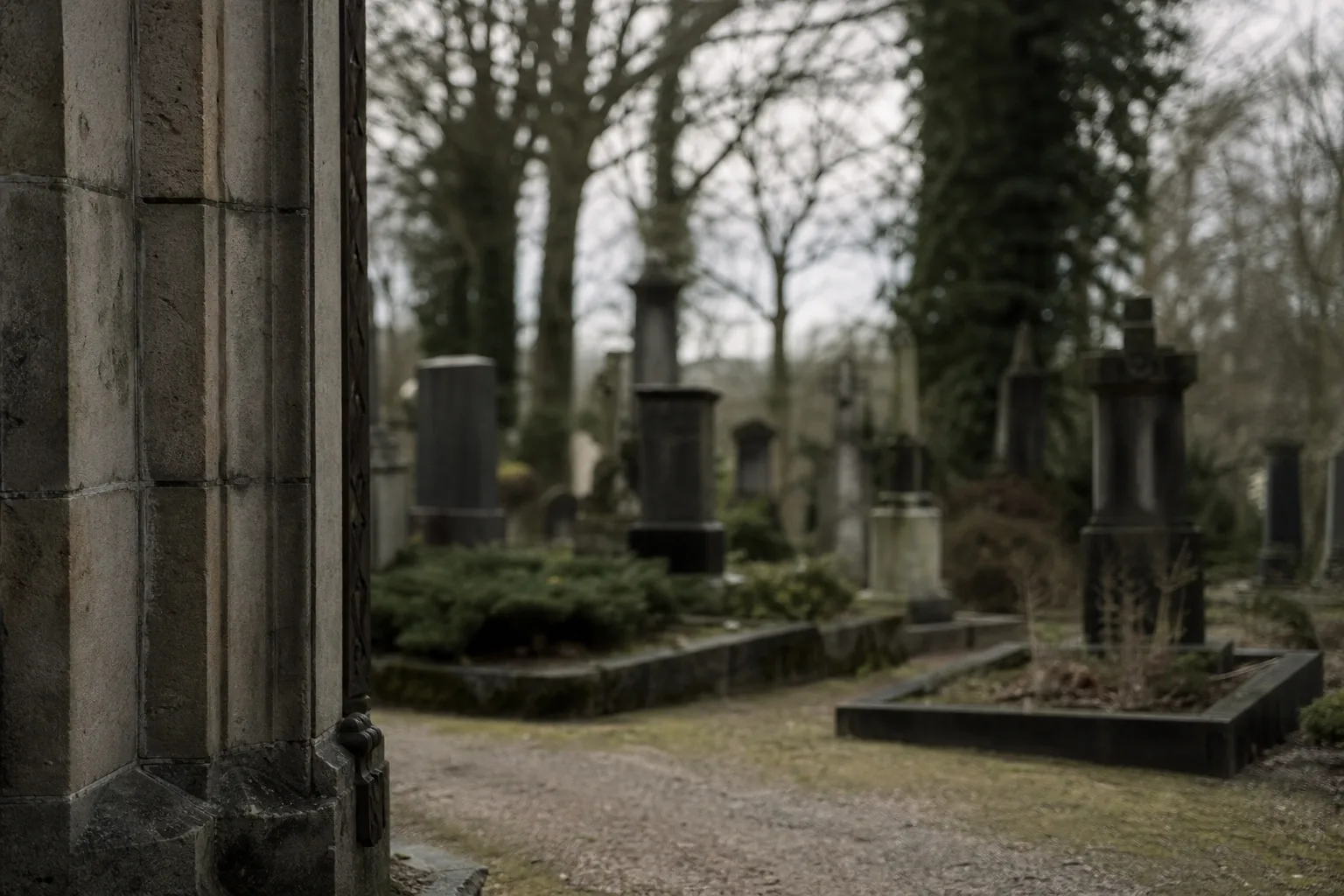
Written after a search for a great-grandmother's grave in Lower Saxony ended at a cleared plot with a picnic bench on it. Covers what a cemetery office actually holds, what a stonemason charges, and who is allowed to renew.
Nobody in your family bought that plot. They rented it, for a fixed run of years, from a municipality or a parish, and what changed hands was a use right called the Nutzungsrecht rather than a piece of land. That distinction is the whole story behind a cleared grave, a missing stone, and a picnic bench sitting where a marker used to stand. American families arrive expecting something like a deed, because that is what a cemetery lot in Ohio or Pennsylvania usually is. In Germany the clock was always running, and someone had to keep feeding it.
Two clocks, and they are not the same clock
The first is the Ruhefrist, the resting period, which is set by state burial law and local ordinance and exists for public health reasons rather than sentimental ones. It runs roughly twenty to thirty years for an adult burial in earth, shorter for cremated remains, longer in heavy clay soil where decomposition is slow. No grave may be reopened or reassigned before it ends. The second clock is the Nutzungszeit, the lease term itself, which is usually set to match or exceed the resting period and can be extended in blocks. Confusing the two is how families conclude a grave was cleared early when it was simply never renewed.
Renewal happens in increments the cemetery office defines: often five, ten, or twenty years for a family plot, sometimes only in a single fixed block for a simple single grave. Each extension resets the expiry date but not the resting period, which has usually long since lapsed. What matters practically is that the office keeps a running record of every extension, every payment, and every change of holder, and that record is the document you actually want when you write from abroad.
Who is allowed to renew, and who is merely interested
The Nutzungsrecht passes to one named person at a time, never to a family collectively, and the order of succession is written into the local Friedhofssatzung, the cemetery statute. Typically it runs to the surviving spouse, then children, then grandchildren, then siblings, in a fixed sequence that the office applies rather than negotiates. The holder can also designate a successor in writing while alive, which is the cleanest route by far and the one German relatives often overlook. If the last holder died in 1974 and nobody stepped forward, the right lapsed at the next expiry, the office sent notice to an address that no longer existed, and the plot was released after the statutory waiting period.
This is why the great-grandparent's grave is almost certainly gone unless a cousin who stayed in the village kept paying. It is also why your first letter should ask a narrow question: who was the last recorded Nutzungsberechtigter, when did the right expire, and is the plot currently reassigned. Offices answer that kind of question readily. They answer vague inquiries about family history much less readily, because that is not their job.
What the money actually looks like
Fees are published in a municipal Gebührenordnung, and they vary enormously by region rather than by any national scale. A single earth grave in a small-town municipal cemetery in Lower Saxony sits at the low end; a family plot in Munich or Hamburg can run many times that for the same number of years. Parish cemeteries, still common in Catholic Bavaria and Lutheran Westphalia, often charge less to registered parishioners and more to everyone else. Forest burial grounds, the Friedwald and Ruheforst type sites, sell a long single term of several decades with no renewal option at all, priced as one payment.
Then there is the stone, which is a separate purchase from a separate business under separate rules. A stonemason charges for the material, the cutting, the lettering by the character, the foundation, and the setting, and the foundation alone is a real line item because most cemeteries require a specified depth and load capacity. Local stone costs less than imported granite; hand-cut lettering costs more than sandblasted. Families comparing German quotes against the price of headstones in the United States should note that in the US the Federal Trade Commission oversees how funeral goods and services must be priced and disclosed, while in Germany the constraint is the cemetery statute dictating what the marker may be before anyone quotes a price.
Deciding what you are actually buying
If the plot is gone, renewal is not on the table, and the honest choice is between a new grave elsewhere, a memorial entry in a cemetery's book of remembrance where one exists, and doing nothing but keeping the record. If the plot survives with a living holder, the question is whether that person will transfer the right to you, which requires a written declaration and the office's acceptance, and whether you are prepared to fund extensions from four thousand miles away for the rest of your life. That is the true cost: not one payment but a standing obligation, renewed on a schedule you do not control, in a currency you do not earn.
Ask the office for the fee schedule and the statute before you decide anything. Both are public, both are usually short, and together they tell you exactly what a grave in that town costs to hold and exactly what you may put on it.